
Diegetic Short Circuits: Metalepsis in Animation (2010) - Erwin Feyersinger
"The hand of the animator reaching into the diegesis of his creations as well as characters communicating with the audience, escaping to the world of their creators or altering their own worlds are all different types of metaleptic transgression"
Example of Fantasmagorie (1908) - Emile Cohl: "The paradoxical amalgamation of two ontologically distinct worlds - in this case the world of a creator and the world of his creations, to which he could not have physical contact in our reality"
 |
| A still from Cohl's Fantasmagorie |
Gerard Genette (1972) on metalepsis; "any intrusion by the extra diegetic narrator or narratee into the diegetic universe (or by the diegetic characters into a metadiegetic universe, etc), or the inverse (as in [Cortazar's short story Continuidad de los Parques]) [which] produces an effect of strangeness that is either comical (when as in [Sterne's Tristram Shardy] or [Diderot's Jaques le Fataliste], it is presented in a joking tone) or fantastic..." (pp. 234-235)
..."All these games, by the intensity of their effects, demonstrate the importance of the boundary they tax in their ingenuity to overstep, in defiance of verisimilitude - a boundary that is precisely the narrating (or the performance) itself:a shifting but sacred frontier between two worlds, the world in which one tells, the world of which one tells" (p.236)
"We believe that we can visually access a world represented by a film (because of its high iconicity), but we neither believe that we can actually see a world represented by a novel (because written words are mainly symbolic signs) nor that a character from a film or novel can see our world. it is also perfectly normal that we can gain imaginary access to a fictional world represented by a written text, but we would be shocked if we could physically enter this world. A metalepsis draws its striking appeal from this shock as it makes the physical transgression possible, albeit only in representation" (p. 281)
Animation Unlimited: Innovative Short Films Since 1940 (2004) - Liz Faber & Helen Walters
Paul Glabicki's Full Moon (2001); "...plays with the very nature of form itself, taking recognizable objects from everyday life and reducing them to their minimum geometric components, before reconstructing them again...to explore an 'imaginary universe of art, nature, beauty, poetry and science'" (p. 10)
Yoichiro Kawaguchi's Eggy (1991); "...attempts to give human intelligence to abstract form" (p. 11)
Len Lye: Colour Cry (1952); Colour Box (1935);
- Making films by directly drawing on celluloid - 'Direct' filmmaking
- "...creating 'pure figures of motion' by painting, stencilling or scratching directly on film" (p. 12)
- Influenced serious application of method to films by Norman McLaren
- http://www.govettbrewster.com/
Stan Brakhage: Mothlight (1963);
- "Brakhage wanted his viewers to be touched in the 'very flesh of our eyes'..." (p. 18)
- Used many different methods to try to recreate the state between being asleep and awake (what he called 'hypnoagogic' vision)
- "In the opening of his 1963 book Metaphos on Vision, Brakhage asks his reader to 'imagine an eye unruled by man-made rules of perpective, an eye unpredjudiced by compositional logic, an eye which does not respond to the name of everything but which must know each object encountered in life through an adventure in perception. How many colours are there in a field of grass to a baby unaware of "green"?" (p. 18)
Erica Russell: Triangle (1994); "Starts with the simple drawing of a triangle, used as a symbol to depict innocence before sophistication. The film sees a man and two women dancing through sequences and playing out emotions, such as innocent love, playfulness, intrusion and persecution. Triangle successfully combines form and abstraction with dance and music" (p. 38)
- Form/abstract/dance/music. Metamophosis; abstract; animated space; playing with laws of physiognomy; music; timing; sense of frame; movement (e.g. Ribbon), etc.
- Form/abstract/dance/music. Metamophosis; abstract; animated space; playing with laws of physiognomy; music; timing; sense of frame; movement (e.g. Ribbon), etc.
 |
| A still from Russell's Triangle (1994) |
Jan Svankmajer: Jabberwocky (1971);
"...first interpretation of the work of Lewis Carroll, of whom he has said, "mentally, we're on the same side of the river". The precursor to his feature film Alice (1987), Jabberwocky features an extraordinary series of inanimate objects coming to life, all to the voiceover of a young girl reading Carroll's poem about the Jabberwock"
"I am still convinced that poetry is the foundation of all forms of art, that it stands in their center and all the rest are but means for grasping it. that also applies to animation. the means are interchangeable" (p. 100)
-Themes; movement; timing with music; 'ironing' scene.
-Themes; movement; timing with music; 'ironing' scene.
 |
| A still from Svankmajer's Jabberwocky (1971) |
 |
| A still from Svankmajer's Dimensions of Dialogue (1982) |
http://drnorth.wordpress.com/2010/12/01/the-short-films-of-jan-svankmajer/
Caroline Leaf: The Street (1976);
"In those days I was someone who felt she could not draw. Sand, as I started using it, was more like an object to push around on a lightbox than it was a drawing medium. I liked its limitations; I liked its reuse-ability" (p. 108)
"The Street depicts a family's reactions to their dying grandmother. Caroline Leaf used paint on glass to show, in soft colours, how harsh amnd unfeeling families can be" (p. 108)
Stuart Hilton: Save Me (1994); Sound and music are integral to Hilton's work: 'Sound in my films helps to make the seemingly abstract imagery begin to operate symbolically and, almost by accident, hint at a lose narrative and drama...it gives the images a tangible reference. the space between what you see and what you hear is full of possibilities'"
Michael Dudok de Wit: Father and Daughter (2000); "Short films can be like poems: intense, timeless and highly personal". "...all his films share a timeless beauty in their illustrative style and great attention is paid to the sound and music design (none of them have dialogue)". "...In my own drawings I enjoy a degree of simple elegance. In my drawings, I am extremely sensitive to atmosphere, light and shadow, and space. The abundant use of shadows has become my favourite visual technique" (p. 178)
- 2D Layers - Trees; dark, shadowy images with light entering window to show passing of time (from night to day); 'Bees' to move down through scene, etc.

Norman McLaren - Creative Process (2002) - The National Film Board of Canada and Milestone
Caroline Leaf: The Street (1976);
"In those days I was someone who felt she could not draw. Sand, as I started using it, was more like an object to push around on a lightbox than it was a drawing medium. I liked its limitations; I liked its reuse-ability" (p. 108)
"The Street depicts a family's reactions to their dying grandmother. Caroline Leaf used paint on glass to show, in soft colours, how harsh amnd unfeeling families can be" (p. 108)
Stuart Hilton: Save Me (1994); Sound and music are integral to Hilton's work: 'Sound in my films helps to make the seemingly abstract imagery begin to operate symbolically and, almost by accident, hint at a lose narrative and drama...it gives the images a tangible reference. the space between what you see and what you hear is full of possibilities'"
Michael Dudok de Wit: Father and Daughter (2000); "Short films can be like poems: intense, timeless and highly personal". "...all his films share a timeless beauty in their illustrative style and great attention is paid to the sound and music design (none of them have dialogue)". "...In my own drawings I enjoy a degree of simple elegance. In my drawings, I am extremely sensitive to atmosphere, light and shadow, and space. The abundant use of shadows has become my favourite visual technique" (p. 178)
- 2D Layers - Trees; dark, shadowy images with light entering window to show passing of time (from night to day); 'Bees' to move down through scene, etc.
 |
Above and below; stills from Dudok de Wit's Father and Daughter (2000) |

Pleix (Geniviève Gauckler & Jean Phillipe Deslandes): Bleip: No (2001); Combination of violent and pretty imagery together with music by Jean Phillipe Deslandes. Gauckler's punk treatise - "it presents a series of words but says "no" to everything...the idea was to express a feeling of malaise, of soft aggresiveness" (p. 88)
- Use of type; music; contrasting imagery
Jean Luc Chancey: Eyen (2001); Line drawings (created by daughter) and metal sculptures. Music - Plaid, published by warp music
- Angles; camera perspectives; movement; themes; collaboration of works between family members - part. use of child's drawings.
Jonathan Hodgson: The Man with the Beautiful Eyes (2000); Use of type (e.g. 'Goldfish'); animated space; metamorphosis; attention to detail (e.g. hair; eyes 'blazed'; etc); narrative; story, etc.
 |
| A still from Hodgson's The Man with the Beautiful Eyes |
Borivoj 'Bordo' Dovnikovic: Exciting Love Story (1989); Simple narrative; use of Characters (crashing through frames; climbing 'hill'; through 'trap door'; 'elevator'; 'rope'; etc) movement through frames; interchanging images (e.g. ice to tunnel); animated space; frame/s being 'shaken'; sections disappearing and reappearing; 'Mickey' and 'Gloria'; music; sound effects; etc
Norman McLaren - Creative Process (2002) - The National Film Board of Canada and Milestone
"What stranger exercise could be inspired in the whole field of art than to make sound visible - to make available to the eyes, those many pleasures which music affords the ears" - Louis Berton Castel
Music having the ability to cross cultural boundaries e.g. music stations of Europe
Metamorphosis and Emile Cohl - Fantasmagorie; "...animation at its purest and best...unaffected by the ideas and methods of other media and earlier times. It rejoiced in the fact that it was drawn with a line and that the line could move. It breathed with this knowledge and followed the logic of it..."
"Hand-made cinema is like watching thought, if thought could be seen"
"...the function of art in MacLaren's brave new world, was to make life gloom proof...for the most part, MacLaren's public art was one of fancy, of wit and of hope. Rarely did his films show his suffering and his pain...this he kept for his private drawings"
"I never use speech in my films...I couldn't. I would feel it an intrusion of a very alien kind..."
On aesthetic value; "You can find that in flowers. If you've imagined yourself a bee...and come in right close to an iris...it looks terribly exciting all this little tube that gets narrower and narrower...all the colours reflecting off...its really a wondrous invention..."
"...Many of the structures in music I've found helpful as guidelines for structures in abstract films, or in films in general"
"...the numerals, by their behavior or action behave as though they were animals or human beings; pushing and shoving and reacting and fighting with each other...the elements take on the personality by virtue of their movements. The images may be abstract, but the movement is not abstract - it's humanly motivated"
"Animation is not the art of drawings that move, but the art of movements that are drawn"
"These films seem in many ways the combination of Norman MacLaren's search for the ultimate in an art that he has made his own. He has stripped the animated film to its barest essentials, in the same way that the more advanced abstract painters stripped pictorial art. But in his march along the last ridge to the summit, he may have left behind his popular touch; and he is likely to find himself almost alone on Everest" - Paul Briggs (1971)
Pas de Deux (1968); Multiplied image; growing love; to capture all the faces of their motion in a single image. Filmed image superimposed on itself several times, but the images are always a few frames behind; obsession with time in film making.
 |
| A still from MacLaren's Pas de Deux (1968) |
A Chairy Tale (1957); "I have sympathy for things that are sat upon...that are exploited"
Stop motion; anthropomorphism; black and white; instrumental music (Indian/Western); faded frame; no dialogue; actions; expressions; text (at beginning and end)
Character traits: Person; curious, persevering, exploratory, insistent, frustrated, determined. Chair; Cheeky, persistent, curious, wanting attention, playful, child-like
Movement is very controlled, at times both fast and jerky, blurred (to show speed, for example in the chase scenes); but also slowed down, smooth, flowing, paused.
Stop motion; anthropomorphism; black and white; instrumental music (Indian/Western); faded frame; no dialogue; actions; expressions; text (at beginning and end)
Character traits: Person; curious, persevering, exploratory, insistent, frustrated, determined. Chair; Cheeky, persistent, curious, wanting attention, playful, child-like
Movement is very controlled, at times both fast and jerky, blurred (to show speed, for example in the chase scenes); but also slowed down, smooth, flowing, paused.
 |
Above and below: Stills from MacLaren's A Chairy Tale (1957) |

Lotte Reiniger & silhouette-style stop-motion
Lotte Reiniger was one of the earliest pioneers of animation. She is widely acknowledged as making the first full length animated feature film - The Adventures of Prince Achmed. She uses a unique silhouette-style of stop-motion with a beautiful handcrafted material quality.

Still from The Adventures of Prince Achmed
The use of shadows or shadow styled animation is an interesting technique to play around with and combine with other styles of animation- mixing 2d and 3d techniques.
Lotte Reiniger has gone on to become a great inspiration for many modern animations.
Current animations inspired by Lotte Reiniger include the 2010 animated sequence by Ben Hibon in Harry Potter and the Deathly Hallows, 'The Tale of the Three Brothers'.
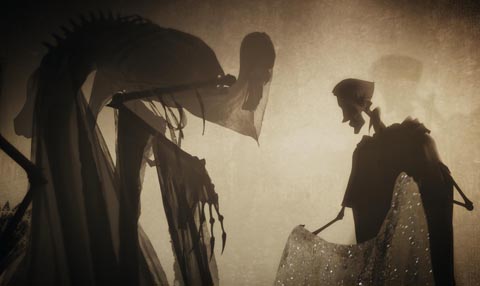
Stills from The Tale of the Three Brothers

The Mysterious Explorations of Jasper Morello (2005) is also inspired by Lotte Reiniger. This animation mixes 2D and 3D animation techniques. It makes use of animated space and places emphasis on material and formal qualities.
The Mysterious Explorations of Jasper Morello
Directed by Anthony Lucas - Short feature film
